Sponsored article
The katana, a revered symbol of Japanese culture and martial prowess, captivates enthusiasts and historians alike with its distinct characteristics. Unlike other historical weapons, the katana boasts a harmonious blend of artistry and functionality. Its curved blade, meticulous craftsmanship, and deep cultural roots set it apart, offering a fascinating insight into the world of traditional Japanese weaponry and its lasting impact. Journey with us to uncover what truly makes the katana unique.
The art of katana craftsmanship is a revered tradition, passed down through generations, embodying the exquisite skills of Japanese swordsmiths. What sets katanas apart from other historical weapons is the meticulous sword-making process that involves multiple expert artisans. Beginning with the selection of tamahagane, a specialized high-carbon steel, the material is repeatedly folded and hammered, which purifies and strengthens the blade. Essential to its unique form and function, the katana is crafted with a remarkable curvature, achieved through differential heat treatment and cooling. This process enables the transition from a flexible spine to a razor-sharp edge, perfecting the balance between resilience and cutting ability.
Traditional Japanese swords require a masterful touch at every stage of production. The attention to detail in creating these samurai weapons is unparalleled, with blade lines and engravings often imbued with cultural and spiritual significance. Elements of katana craftsmanship include:
To explore more about these incredible weapons and possibly own a piece of this artistry, visit Medieval Depot for a diverse selection of katanas and other Japanese swords. You can read more about this topic at https://www.medievaldepot.com.
The katana holds a distinctive place in Japanese heritage, embodying both martial prowess and spiritual significance. Originating in the feudal era, the katana is more than just a weapon; it is a symbol of the samurai class, reflecting the values of honor, discipline, and duty cherished by the warrior elite. In samurai history, the katana was regarded as a “soul of the samurai,” an extension of their being, which intertwined their fate with the finely crafted steel. The sword’s elegant curvature and sharpness were not only practical in combat but also emblematic of the samurai’s esteemed status, embodying the pinnacle of sword symbolism.
The cultural impact of the katana extends beyond its use in battlefields; it is a prominent motif in Japanese art and literature, often depicted as a tool of justice and an object of philosophical contemplation. From classical ukiyo-e prints to contemporary films, katana culture continues to inspire, illustrating its enduring legacy in shaping Japanese identity. Even today, the katana serves as a captivating icon of tradition, drawing enthusiasts worldwide who appreciate its artistry and historical importance, cementing its place in global cultural consciousness.
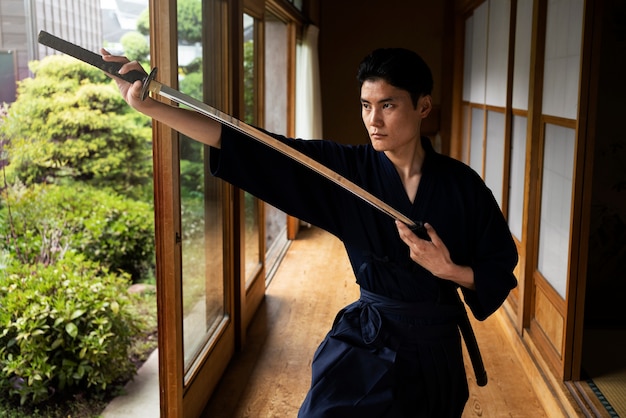
The katana, a sword that epitomizes the artistry and precision of traditional Japanese weaponry, is celebrated for its distinct curved blade which significantly contributes to its unique design characteristics. This curvature is not merely aesthetic but serves a practical purpose, enhancing the sword’s cutting ability and making it a formidable asset in swift, fluid combat. Unlike straight-bladed swords, the curved blade allows for increased cutting efficiency, particularly during slashing motions, which are central to the katana’s use in combat. Furthermore, the katana design is noteworthy for its balance, which ensures that it feels almost weightless in the hands of a skilled swordsman, allowing for precise and agile movements.
Among its sword features, the katana’s sharpness is legendary, traditionally honed through elaborate techniques that give it an edge capable of slicing through targets with minimal resistance. This sharpness, combined with its exceptional balance, renders the katana highly effective in combat situations, where speed and precision are paramount. The practicality of this weapon in battle scenarios is further emphasized by the technique of drawing and striking in a singular motion, a hallmark of katana mastery. These integrated aspects of katana design distinguish it from other historical weapons, securing its place as a symbol of both beauty and lethality.